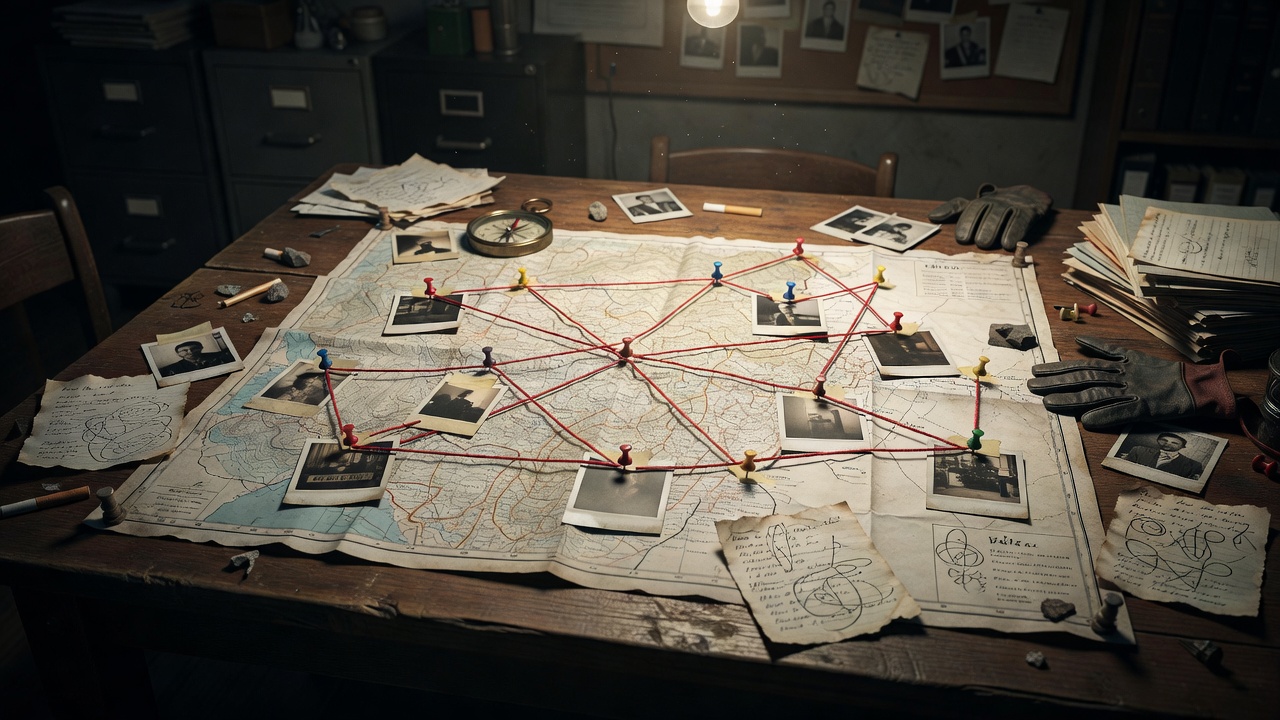
01 · The Investigative Method
Internet mysteries are rarely solved by a single breakthrough. They are solved — or at least clarified — by patient documentation. The best community investigations, from the Cicada 3301 solvers to the Reddit teams decoding Unfavorable Semicircle frames, followed the same discipline.
Step 1 — Capture the artefact
Archive everything before it disappears. Save original files, record URLs, and submit pages to the Internet Archive. Content on social platforms can vanish in hours.
Step 2 — Establish provenance
Who posted it first, where and when? Search archived threads, check timestamps and compare against independent captures. Most "mysteries" collapse when the true origin is found.
Step 3 — Build a timeline
Pin each development to a date and a source. Timelines reveal patterns — automation, coordination, or the moment a hoaxer joined in.
Step 4 — Separate facts from theories
- Label every claim as confirmed, probable or speculative.
- Prefer primary sources over videos summarising other videos.
- Record who disproved what, and how.
02 · The Digital Detective's Toolkit
These freely available, widely trusted tools form the backbone of most open-source investigations:
Wayback Machine
View historical snapshots of websites and save new captures.
TinEye
Reverse image search to find the earliest appearance of a photo.
CyberChef
Decode Base64, hex, ciphers and more — directly in the browser.
ExifTool
Read metadata embedded in images, audio and documents.
ICANN Lookup
Check domain registration data and creation dates.
Sonic Visualiser
Inspect spectrograms for images and messages hidden in audio.

03 · The Rules of Ethical Investigation
- Never dox. Do not publish names, addresses or personal details of suspected creators or bystanders.
- Respect real people. Cases involving deaths or victims deserve restraint; we deliberately exclude them from our archive.
- Don't trespass. Never access systems, accounts or locations without permission — even to "solve" a puzzle.
- Correct publicly. If a theory you shared is disproved, say so where you shared it.
- Credit solvers. Link to the communities and individuals who did the work.
04 · How to Spot a Hoax
The success of genuine mysteries inspires imitators. Cicada 3301's organisers used a single PGP key precisely so that fakes could be identified. Watch for these red flags:
- No traceable first appearance — the "original" is always a repost.
- Metadata that contradicts the claimed date.
- Monetised channels promising answers "in part two".
- Images that appear years earlier in stock libraries or unrelated contexts.
- Claims that cannot be checked against any independent archive.
05 · Beyond the Archive: Phenomena Worth Exploring
These well-documented stories sit at the edges of our case files and reward further reading:

The Max Headroom Signal Hijacking (1987)
Chicago TV broadcasts were interrupted by a masked figure; the perpetrators were never identified. The footage became early internet legend.

Polybius
An alleged 1981 arcade cabinet with sinister side-effects. Almost certainly urban legend — but a masterclass in how internet lore forms.

Ted the Caver (2001)
An Angelfire blog chronicling a cave exploration that grows steadily stranger — one of the earliest viral online horror stories.
Lake City Quiet Pills
A mid-2000s website investigated by Reddit in 2019 for allegedly hiding coded content in its image galleries. Many claims remain disputed.
06 · Glossary of Digital Mystery Terms
- ARG
- Alternate Reality Game — a narrative that uses the real world and internet as its platform.
- Steganography
- Hiding data inside another file, such as text concealed in an image.
- PGP Signature
- A cryptographic proof that a message came from the holder of a specific key.
- Creepypasta
- Horror stories copied and shared across forums, often presented as true.
- Link Rot
- The decay of hyperlinks as pages move, die or are taken over.
- Liminal Space
- Transitional, empty environments that feel uncanny — the aesthetic of The Backrooms.
- Numbers Station
- Shortwave broadcasts of spoken number sequences, widely believed to be espionage messages.
- OSINT
- Open-Source Intelligence — investigation using publicly available information.
Ready to open a case?
Put the method into practice with our eight curated case files.
Browse Case Files